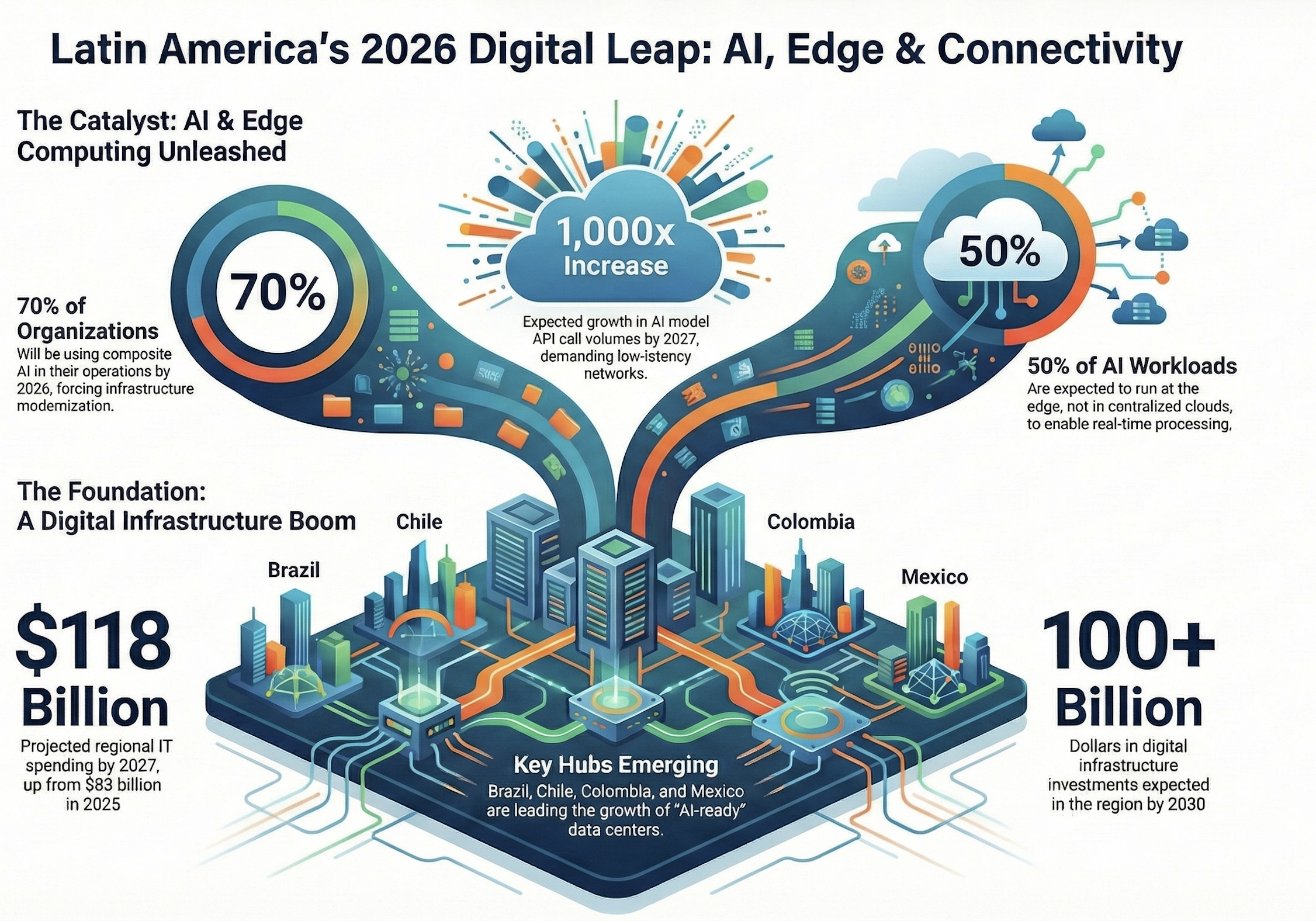
Latin America’s digital connectivity is rapidly expanding, enabling a new era of cloud, AI, and edge computing. As investments in fiber optics and 5G accelerate, the region is poised for a total digital transformation by 2026. From Mexico to Brazil, high-speed access is enabling innovation and economic growth on an unprecedented scale.
The Infrastructure Boom: A $118 Billion Market
The enterprise IT market in Latin America is on a steep growth trajectory. Regional spending is projected to climb from $93 billion in 2025 to nearly $118 billion by 2027. This surge is driven by telcos and cloud providers investing in data centers to meet the massive demand for connectivity.
By 2030, the region could attract over $100 billion in digital infrastructure investments as global hyperscalers build out capacity. Key hubs like Brazil, Chile, Colombia, and Mexico are already emerging as “AI-ready” markets.
Modernizing for an “AI Everywhere” Reality
Artificial Intelligence is the primary engine behind this infrastructure race. By 2026, 70% of organizations in the region will utilize composite AI—a blend of generative AI, predictive analytics, and intelligent agents.
This shift is forcing a massive modernization of the IT stack. By 2027, an estimated 80% of organizations will have reinvented their cloud and on-premises environments specifically to handle AI workloads. Meanwhile, traditional data centers are being retrofitted with GPU servers. They are also equipped with high-performance storage to support the massive parallel processing required for machine learning.
The Rise of the “Agent Economy”
The scale of this shift is difficult to overstate. Global enterprises expect a 10x increase in AI-driven agents. Additionally, there will be a staggering 1,000x increase in AI model API call volumes by 2027. Because every millisecond matters for an autonomous agent or digital assistant, infrastructure must support ultra-low latency and high throughput at scale.
The Edge Imperative: Bringing Power to the User
To meet these low-latency demands, companies are shifting compute power from distant central clouds to the edge. By the end of the decade, half of all enterprise AI inference workloads could be running on endpoints or edge nodes.
- Speed: Running AI on a local edge node in São Paulo or Bogotá—rather than in a cloud region thousands of miles away—drastically reduces latency.
- Capacity: High-capacity fiber loops and new subsea cables, such as Google’s Firmina and the Humboldt cable, are increasing international bandwidth for these global data flows.
- Scale: Providers like EdgeUno now operate over 50 points of presence across Latin America. This allows workloads to be placed precisely where they deliver the best performance.
By 2026, the convergence of AI and Edge will be visible in daily life across various sectors:
- Finance: Banks are using low-latency networks for real-time payments. A credit card transaction in Bogotá can be analyzed by an AI model at the edge and verified in milliseconds.
- Healthcare: Specialists in major cities can conduct HD consultations with patients in remote Amazonian towns thanks to expanded broadband and edge caching.
- Manufacturing: Factories in Monterrey or São Paulo use thousands of IoT sensors to stream data to on-site edge platforms. This enables real-time detection of production anomalies.
- Telecommunications: Telcos are rolling out 5G standalone networks and adopting “self-driving network” AI to optimize traffic and predict outages.
Security and Trust in the Cloud Era
As data volumes grow, so does the need for data collaboration. By 2028, 60% of enterprises will participate in secure data exchanges, or “clean rooms.” They will collaboratively leverage data for AI training and fraud detection. This requires infrastructure that is not only fast but also trusted—emphasizing data sovereignty, encryption, and compliance with evolving local laws.
From Potential to Reality
The year 2026 will be a milestone for Latin America. Organizations that successfully weave connectivity, edge, and AI into a cohesive platform could see 15% higher operating margins by 2029. Consequently, with the digital groundwork now falling into place, the region is no longer just participating in the Fourth Industrial Revolution—it is helping to lead it