EdgeUno ofrece IP Transit, Bare Metal, y Cloud servicios a través de data centers de borde en cinco ciudades de EE. UU. Estos servicios de data center cubren conectividad, cómputo y seguridad de borde en un solo lugar.
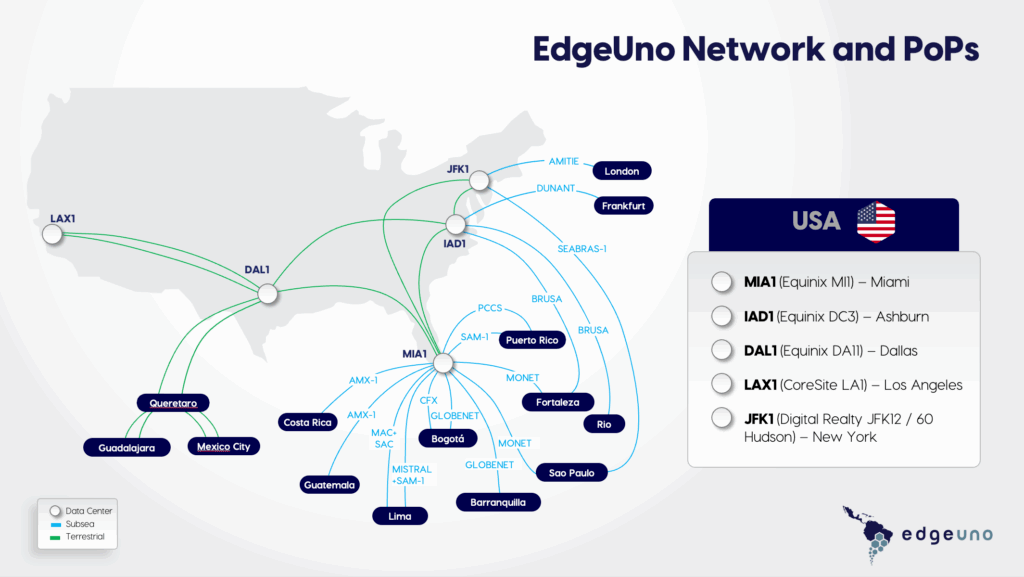
Nuestros hubs se encuentran en Miami, New York, Dallas, Los Angeles, y Ashburn. Estos son algunos de los hubs de internet más críticos en los Estados Unidos. Los data centers desempeñan un papel fundamental en la rapidez y fiabilidad con la que sus usuarios pueden alcanzarle, y la ubicación decide gran parte de esto.
Ya sea que esté expandiéndose regionalmente, ingresando a Latinoamérica o optimizando la entrega global, EdgeUno le proporciona la infraestructura de data center para escalar de manera segura y eficiente.
¿Necesita ayuda para planificar su despliegue? Hable con un especialista de EdgeUno.
Cobertura Nacional, Plataforma Unificada
En todas las cinco ubicaciones de EE. UU., EdgeUno proporciona:
- IP Transit con latencia ultrabaja y acceso directo a AS7195, la red IP latinoamericana más conectada
- Servidores Bare Metal bajo demanda, diseñados para rendimiento y flexibilidad
- Servicios Cloud para cargas de trabajo modernas y escalables
- Seguridad Edge, incluyendo mitigación de DDoS y monitoreo de tráfico
Los cuatro funcionan en una plataforma unificada. Usted obtiene control y visibilidad completos, sin importar dónde estén sus usuarios.
La adopción de IA está incrementando la demanda de electricidad de los centros de datos en toda la industria. El La Agencia Internacional de Energía proyecta que los centros de datos utilizarán alrededor de 945 terawatt-hours de electricidad para 2030. Esto es más del doble de su uso en 2024. Esto convierte las operaciones eficientes de los centros de datos en un factor real cuando usted elige un proveedor.
¿Qué tipos de centros de datos existen hoy?
Centros de datos explicados de forma sencilla: son la infraestructura física que almacena, procesa y mueve datos. Existen varios tipos comunes de centros de datos, y conocerlos le ayuda a elegir las opciones de centro de datos adecuadas para empresas y otras compañías tecnológicas en proceso de transformación digital.
- Centros de datos tradicionales. Este es un centro de datos operado por la empresa y propiedad y gestión completamente internos, incluyendo equipos de red, sistemas de almacenamiento de datos y sistemas de refrigeración.
- Centros de datos de hiperescala. Instalaciones grandes de centros de datos que pueden albergar desde miles hasta millones de servidores. Son algunos de los centros de datos más grandes del mundo, y empresas tecnológicas como Amazon y Google los operan para ejecutar sus propios centros de datos en la nube. El mercado de centros de datos de hiperescala creció de $35.72 mil millones en 2022 a $41.69 mil millones en 2023, con una CAGR del 16.7 por ciento.
- Centros de datos de colocación. Un centro de datos de colocación aloja la infraestructura de TI de múltiples organizaciones bajo un mismo techo. Las instalaciones de colocación permiten a las empresas alquilar espacio en racks en lugar de construir el propio, lo que reduce el gasto de capital y añade escalabilidad. Este es el modelo que utiliza EdgeUno.
- Centros de datos de borde. Instalaciones más pequeñas y regionales ubicadas cerca de los usuarios finales para reducir la latencia. El mercado de centros de datos de borde valía $9.36 mil millones en 2022 y se proyecta que alcance $34.91 mil millones para 2030, con una CAGR del 17.9 por ciento.
- Modular data centers. Portable data centers, often built into shipping containers with their own cooling systems and power supplies. They can deploy quickly in remote locations.
Other data centers, like government or research facilities, exist too, but these four cover most of the commercial data center landscape. The key components across all of them are the same: power, cooling, networking equipment, and physical space.
How Are AI Data Centers Different?
Artificial intelligence and machine learning need more than a standard setup. There are two main types of AI data centers, split by function: training and inference.
AI training data centers ingest petabytes of data to build large models. They need vast GPU clusters, high-throughput storage systems, and low-latency networking like InfiniBand. This heavy data processing is one reason powering AI data centers takes so much more energy than a standard facility.
Power use per rack can run from 60 kW to over 140 kW, according to industry rack-density benchmarks. That is far more than a conventional data center needs. Because of this, training facilities often sit in remote areas with cheaper power.
Centros de datos de inferencia de IA ejecutan modelos entrenados para uso en vivo, como chatbots o herramientas de recomendación. Estas cargas de trabajo priorizan la baja latencia sobre la potencia bruta, por lo que las instalaciones se sitúan más cerca de los usuarios finales. El consumo de energía también es menor, típicamente entre 10 kW y 30 kW por rack.
Un centro de datos listo para IA requiere sistemas robustos de energía y refrigeración, además de una conectividad rápida. Las Conectividad AI soluciones de EdgeUno están diseñadas para la parte de inferencia de esta ecuación. Las cargas de trabajo de inferencia y IA, sensibles a la latencia, se benefician más de la infraestructura ubicada cerca de las personas que las utilizan.
¿No sabe qué configuración de centro de datos de IA se adapta a su carga de trabajo? Hable con un especialista de EdgeUno en cuanto a las necesidades de entrenamiento versus inferencia.
¿Cómo miden la eficiencia los operadores de centros de datos?
Los centros de datos críticos para las operaciones comerciales diarias requieren una supervisión real, motivo por el cual el diseño inteligente del centro de datos es de suma importancia. Los operadores monitorean el rendimiento de sus instalaciones utilizando métricas reales, no con suposiciones.
Una métrica común es la efectividad de uso de energía (PUE). Compara la potencia total de la instalación con la potencia que realmente llega al equipo informático. Un PUE más bajo indica una mejor eficiencia energética.
Una buena gestión del centro de datos también depende de la capa de red. Muchos operadores ahora utilizan redes definidas por software (SDN), uno de varios componentes del centro de datos junto con servidores, racks y sistemas de refrigeración, para gestionar el tráfico sin reconfigurar hardware manualmente. Esto facilita la expansión de la capacidad del centro de datos a medida que crece la demanda.
La industria de centros de datos también se está moviendo hacia los centros de datos de servicios gestionados, donde el proveedor se encarga de las operaciones diarias, y no solo del espacio y la energía. Este cambio permite a las empresas saltarse por completo el costo y el tiempo de construcción de un centro de datos.
La tecnología más moderna de centros de datos, desde la monitorización remota hasta el enfriamiento automatizado, hace posible esta transición. Para muchas empresas, la colocalización en centros de datos como la de EdgeUno es simplemente la forma más rápida de acceder a esta tecnología sin tener que construirla internamente.
Un vistazo más cerca a los Centros de EE. UU.
- Miami (MIA1): Una puerta de entrada a Latinoamérica con disponibilidad de servicios full-stack. Ideal para empresas que se expanden a LATAM o que atienden tráfico transcontinental.
- New York (JFK1): Ubicado en 60 Hudson. Construido para aplicaciones financieras, de alta frecuencia y empresariales que requieren un rendimiento de primer nivel.
- Dallas (DAL1): Ubicación central para alcance y redundancia a nivel nacional. Ideal para implementaciones de borde (edge) y optimización de latencia.
- Los Angeles (LAX1): Interconexión directa con Asia-Pacífico. Construido para negocios que llegan a audiencias a través de costas y más allá.
- Ashburn (IAD1): Ubicado en la mayor concentración mundial de centros de datos, lo que le ofrece una fuerte interconectividad.
Cada hub es un centro de datos de colocation neutro para carriers, construido bajo los estándares Tier III y Tier IV, los dos niveles más comunes para uso comercial. Nunca queda limitado a una red upstream. Cada sitio incluye sistemas de control de acceso y otras medidas de seguridad física para proteger a los clientes de centros de datos empresariales y sus datos sensibles.
Para las empresas que están evaluando proveedores de centros de datos, la residencia de datos también es crucial. Las regulaciones de protección de datos en América Latina y EE. UU. a menudo exigen que los datos sensibles permanezcan en fronteras específicas. La combinación de hubs de EE. UU. y más de 50 instalaciones de EdgeUno en América Latina ofrece a las empresas soluciones escalables que mantienen los datos dentro de las normativas que los rigen.
¿No está seguro de qué hub se adapta a su tráfico? Contacte a un especialista de EdgeUno para definirlo.
LA VENTAJA EDGEUNO
🌐 Conectado globalmente, optimizado regionalmente
🔒 Diseño centrado en la seguridad con mitigación DDoS integrada
🧠 Soporte experto en inglés, español y portugués
🔧 Despliegues escalables con flexibilidad Cloud y Bare Metal
Data center architecture and data center space needs vary by workload. A company running enterprise resource planning software has different computing resource needs than one running an AI inference pipeline, and both can be hosted through EdgeUno’s colocation and cloud data centers.
EdgeUno’s Cloud Connect service links directly to major cloud service providers, including AWS, Google Cloud Platform, Microsoft Azure, and Oracle Cloud. That gives you private, low-latency data center communications between your colocated equipment and the public cloud, without routing traffic over the open internet.
As demand grows for AI and data-heavy applications, modern data center expansion is accelerating across the industry, and how much electricity data centers consume is rising with it. Good data management starts with picking infrastructure built to handle that growth.
Demand for this kind of infrastructure keeps growing. MarketsandMarkets projects the global edge data center market will grow from $50.86 billion in 2025 to $109.20 billion by 2030. AI, IoT, and real-time applications are the biggest drivers behind that growth.
Whether you’re launching a new product, evaluating an Proveedor de IP transit, or building AI-ready infrastructure, EdgeUno provides the speed, security, and resilience you need.
¿Listo para escalar con confianza?
Your infrastructure deserves more than a data center. It needs a strategic partner. Contactar a EdgeUno y descubra cómo nuestra presencia en EE. UU. puede impulsar su próximo movimiento.
