EdgeUno 提供 IP Transit, Bare Metal和 云 通过美国五座城市的边缘数据中心提供服务。这些数据中心服务涵盖连接性、计算和边缘安全,一站式解决。
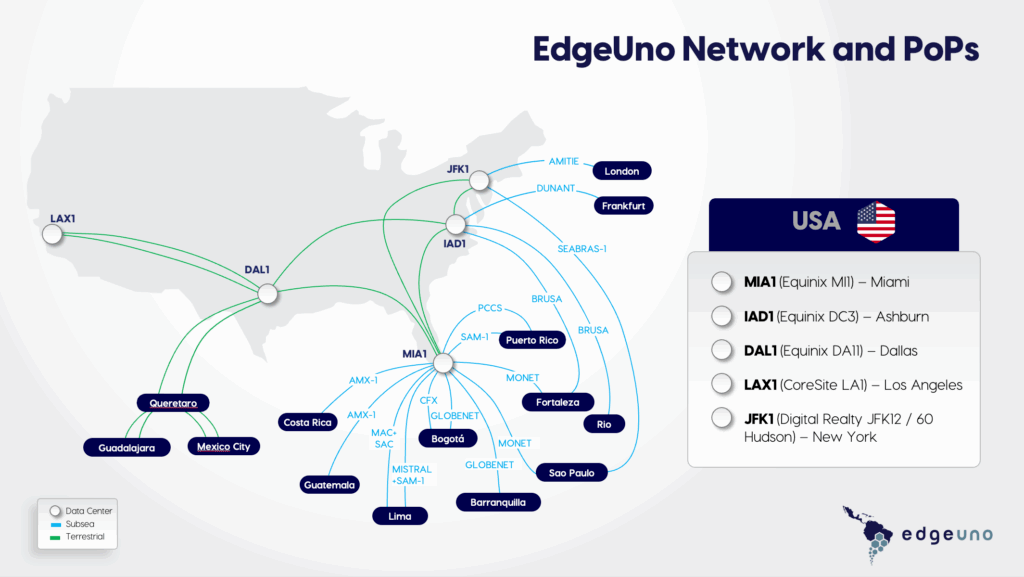
我们的枢纽位于 Miami, New York, Dallas, Los Angeles, 和 Ashburn. 这些是美国最关键的互联网枢纽之一。数据中心在您的用户能否快速可靠地访问您方面发挥着核心作用,而地理位置决定了其中的很大一部分。
无论您是进行区域扩张、进入拉丁美洲,还是优化全球交付,EdgeUno 都为您提供可安全高效扩展的数据中心基础设施。
需要协助规划部署吗? 联系EdgeUno专家.
全国覆盖,统一平台
在所有五个美国地点,EdgeUno提供:
- IP Transit,超低延迟,并可直接接入 AS7195,这是拉丁美洲连接性最强的 IP 网络
- 按需裸金属服务器,专为高性能和灵活性而构建
- 适用于现代、可扩展工作负载的云服务
- 边缘安全,包括DDoS缓解和流量监控
所有四种服务均在一个统一平台运行。无论您的用户身处何地,您都能获得完全的控制和可见性。
AI的采用正在推动整个行业的数据中心电力需求上升。而 国际能源署预测 到2030年,数据中心消耗的电力将达到约945 terawatt-hours。这比2024年的用量翻了一倍多。因此,高效的数据中心运营成为您选择服务提供商时必须考虑的关键因素。
当前存在哪些类型的数据中心?
数据中心简单来说:它是存储、处理和传输数据的物理基础设施。市面上有几种常见的数据中心类型,了解这些类型有助于您为正在进行数字化转型的企业和其他科技公司选择合适的方案。
- 传统数据中心。 这是一种公司自建的数据中心,由公司内部完全拥有和运营,包括网络设备、数据存储系统和冷却系统。
- 超大规模数据中心。 能够容纳数千到数百万台服务器的大型数据中心设施。这是全球最大的数据中心之一,科技巨头如Amazon和Google利用它们来运行自有云数据中心。 hyperscale data center market 从2022年的$35.72 billion增长到2023年的$41.69 billion,复合年增长率(CAGR)为16.7 percent。
- 托管数据中心。 托管数据中心在一个屋檐下为多个组织提供IT基础设施的承载。通过托管设施,企业无需自建,只需租赁机架空间,从而降低了资本支出并提高了可扩展性。这也是EdgeUno采用的模式。
- 边缘数据中心。 部署在离终端用户较近的较小型区域设施,用于降低延迟。该 edge data center market 在2022年价值$9.36 billion,预计到2030年将达到$34.91 billion,复合年增长率(CAGR)为17.9 percent。
- 模块化数据中心。 便携式数据中心通常内置于集装箱中,配备独立的冷却系统和电源。它们能够快速部署到偏远地区。
此外,还存在政府或研究设施等其他数据中心,但这四种涵盖了大多数商业数据中心类型。所有这些数据中心的核心组件是相同的:电力、冷却、网络设备和物理空间。
AI数据中心有何不同?
人工智能和机器学习所需的配置比标准设置更为复杂。AI数据中心主要分为两大类型,根据功能划分:训练和推理。
AI训练数据中心 它们摄取PB级数据以构建大型模型。它们需要庞大的GPU集群、高吞吐量存储系统以及像InfiniBand这样的低延迟网络。这种繁重的数据处理是AI数据中心比标准设施消耗更多能源的原因之一。
根据每机架的功耗可从60 kW到超过140 kW, 行业机柜密度基准。这远超传统数据中心的需求。因此,训练设施通常位于拥有更廉价电力资源的偏远地区。
AI 推理数据中心 运行训练好的模型用于实时应用,例如聊天机器人或推荐工具。此类工作负载更关注低延迟而非原始算力,因此设施靠近最终用户。功耗也较低,通常每机架 10 kW 至 30 kW。
具备 AI 能力的数据中心需要强大的电源、冷却系统和高速网络。EdgeUno 的 AI Connectivity 解决方案专为推理侧设计。对延迟敏感的推理和 AI 工作负载,从部署在用户附近的基础设施中获益最大。
不确定哪种 AI 数据中心配置适合您的工作负载? 联系EdgeUno专家 关于训练和推理需求。
数据中心运营商如何衡量效率?
对日常业务运营至关重要的数据中心需要真实的监控,因此智能数据中心设计至关重要。运营商使用实际指标而非猜测来跟踪其设施的运行情况。
一个常见的指标是电源使用效率,即 PUE。它将总设施电力与实际到达计算设备的电力进行比较。较低的 PUE 表示更高的能源效率。
良好的数据中心管理还取决于网络层。许多运营商现在使用软件定义网络,它是服务器、机架和冷却系统等多种数据中心组件之一,以无需手动重新配置硬件来管理流量。这使得随着需求增长,数据中心容量更容易扩展。
数据中心行业也正转向托管服务数据中心,在这种模式下,服务提供商负责日常运营,而不仅仅是提供空间和电力。这一转变使贵公司能够完全跳过数据中心建设所需的时间和成本。
从远程监控到自动化冷却等新型数据中心技术,使得这一转型成为可能。对于许多企业而言,像 EdgeUno 这样的数据中心托管服务,是无需自建就能最快获取这些技术的途径。
深入了解我们的美国中心
- Miami (MIA1): 这是通往拉丁美洲的门户,提供全栈服务。非常适合正在扩展到 LATAM 或提供跨大陆流量服务的公司。
- New York (JFK1): 位于 60 Hudson。专为需要顶级性能的高频交易、金融和企业级应用而构建。
- Dallas (DAL1): 地理位置中心,具备全国覆盖和冗余能力。非常适合边缘部署和延迟优化。
- Los Angeles (LAX1): 与亚太地区直连。专为服务跨海岸甚至更远地区受众的企业而构建。
- Ashburn (IAD1): 位于全球最大的数据中心聚集地,为您提供强大的互联互通性。
每个枢纽均为中立运营商的托管数据中心,遵循Tier III和Tier IV标准(商业使用最常见的两个数据中心等级)。您不会被单一上游网络锁定。每个站点均配备访问控制系统及其他物理安全措施,以保护企业数据中心客户及其敏感数据。
对于正在评估数据中心提供商的企业,数据驻留同样重要。拉丁美洲和美国的数据保护法规通常要求敏感数据必须保留在特定边界内。EdgeUno结合了美国枢纽和50多个拉丁美洲设施,为企业提供了可扩展的数据中心解决方案,确保数据符合相关法规。
不确定哪个枢纽适合您的流量? 联系EdgeUno专家 协助规划。
EdgeUno优势
🌐 全球互联,区域优化
🔒 安全优先设计,集成DDoS缓解功能
🧠 英语、西班牙语和葡萄牙语专家支持
🔧 支持Cloud和Bare Metal灵活部署的可扩展性
Data center architecture and data center space needs vary by workload. A company running enterprise resource planning software has different computing resource needs than one running an AI inference pipeline, and both can be hosted through EdgeUno’s colocation and cloud data centers.
EdgeUno’s Cloud Connect service links directly to major cloud service providers, including AWS, Google Cloud Platform, Microsoft Azure, and Oracle Cloud. That gives you private, low-latency data center communications between your colocated equipment and the public cloud, without routing traffic over the open internet.
As demand grows for AI and data-heavy applications, modern data center expansion is accelerating across the industry, and how much electricity data centers consume is rising with it. Good data management starts with picking infrastructure built to handle that growth.
Demand for this kind of infrastructure keeps growing. MarketsandMarkets projects the global edge data center market will grow from $50.86 billion in 2025 to $109.20 billion by 2030. AI, IoT, and real-time applications are the biggest drivers behind that growth.
Whether you’re launching a new product, evaluating an IP Transit Provider, or building AI-ready infrastructure, EdgeUno provides the speed, security, and resilience you need.
准备好自信扩展了吗?
Your infrastructure deserves more than a data center. It needs a strategic partner. 联系EdgeUno 了解我们的美国部署如何助力您的下一步行动。
